
Techno & The Neuroendo
7 min read
Your neuroendocrine system will respond to the playlist at the end of this page.

A warehouse. 3 AM. The kick drum arrives at 140 beats per minute, relentless and bone-deep. Something shifts — not just in the room, but inside you.
Praise the 90’s!
In 1998, a team of Italian researchers led by G. Gerra published a study in the International Journal of Psychophysiology that would become one of the most cited pieces of evidence that electronic music does something measurable to the human body's internal chemistry. Their paper, "Neuroendocrine responses of healthy volunteers to 'techno-music': relationships with personality traits and emotional state," set out to do something deceptively simple: draw blood from young people before and after listening to techno, and see what changed. What they found was remarkable. The beat was rewriting hormones.
This is a story about that study, about what the neuroendocrine system is and why it matters, about the new science of psychedelic medicine that is using these same biological levers as targets for healing, and about the strange, beautiful convergence of electronic music, chemistry, and consciousness research unfolding right now.
The Gerra Study: Blood Tests at the Rave
Sixteen healthy volunteers between 18 and 19 years old (eight male, eight female) were recruited and exposed in random order to two distinct listening conditions: 30 minutes of techno music and 30 minutes of classical music. Before and after each session, researchers drew blood and measured an extensive panel of neurochemical markers including plasma norepinephrine (NE), epinephrine (EPI), growth hormone (GH), prolactin (PRL), adrenocorticotropic hormone (ACTH), cortisol (CORT), and beta-endorphin (β-EP). Participants also completed psychometric assessments of their emotional state and were evaluated for personality traits using the Cloninger temperament scale.
The contrast between the two music conditions was stark. Classical music produced improvements in emotional state; participants felt calmer, more at ease, but showed no significant hormonal shifts. Techno, on the other hand, mobilised the body's chemistry in ways more commonly associated with physical exertion or psychological stress.
Norepinephrine rose significantly, indicating activation of the noradrenergic arousal system. Beta-endorphin, the body's endogenous opioid, the same molecule released during intense exercise and laughter, climbed markedly. ACTH, a key driver of the stress-hormone cascade, suggested HPA axis activation without any physical stressor present. Growth hormone, cortisol, and heart rate all followed suit.
Significant changes were visible across neurotransmitters, peptides, hormones, mental state, and emotional involvement, with personality traits influencing the wide inter-individual variability in responses to the music. In other words, the beat didn't hit everyone equally — one’s internal wiring shaped how hard it landed.
Changes in emotional state and norepinephrine, beta-endorphin, and growth hormone responses to techno music correlated negatively with harm avoidance scores and positively with novelty-seeking temperament scores on the Cloninger scale. High novelty-seekers, thrill-chasers, experiencers, the people who live for the drop mounted the strongest hormonal responses. The rave, it turns out, is a biologically self-selecting space. As the researchers put it: "Listening to techno-music induces changes in neurotransmitters, peptides and hormonal reactions related to mental state and emotional involvement: personality and temperament may influence the wide inter-individual variability."
The researchers also noted that the psychoneuroendocrine changes induced by techno music exposure could suggest the existence of a biological co-factor linking this kind of music with the use of stimulants and after-hours dancing. The body, it seems, was partially producing its own internal stimulant show, even before any substance entered the equation. The music alone was enough to move hormones.
The Architecture of Inner Chemistry
To understand why the Gerra study matters so profoundly, you need to understand the system it was measuring. The neuroendocrine system is a continuous loop of signaling between the brain and the body that governs almost everything about how you feel, how you cope, and how you heal.
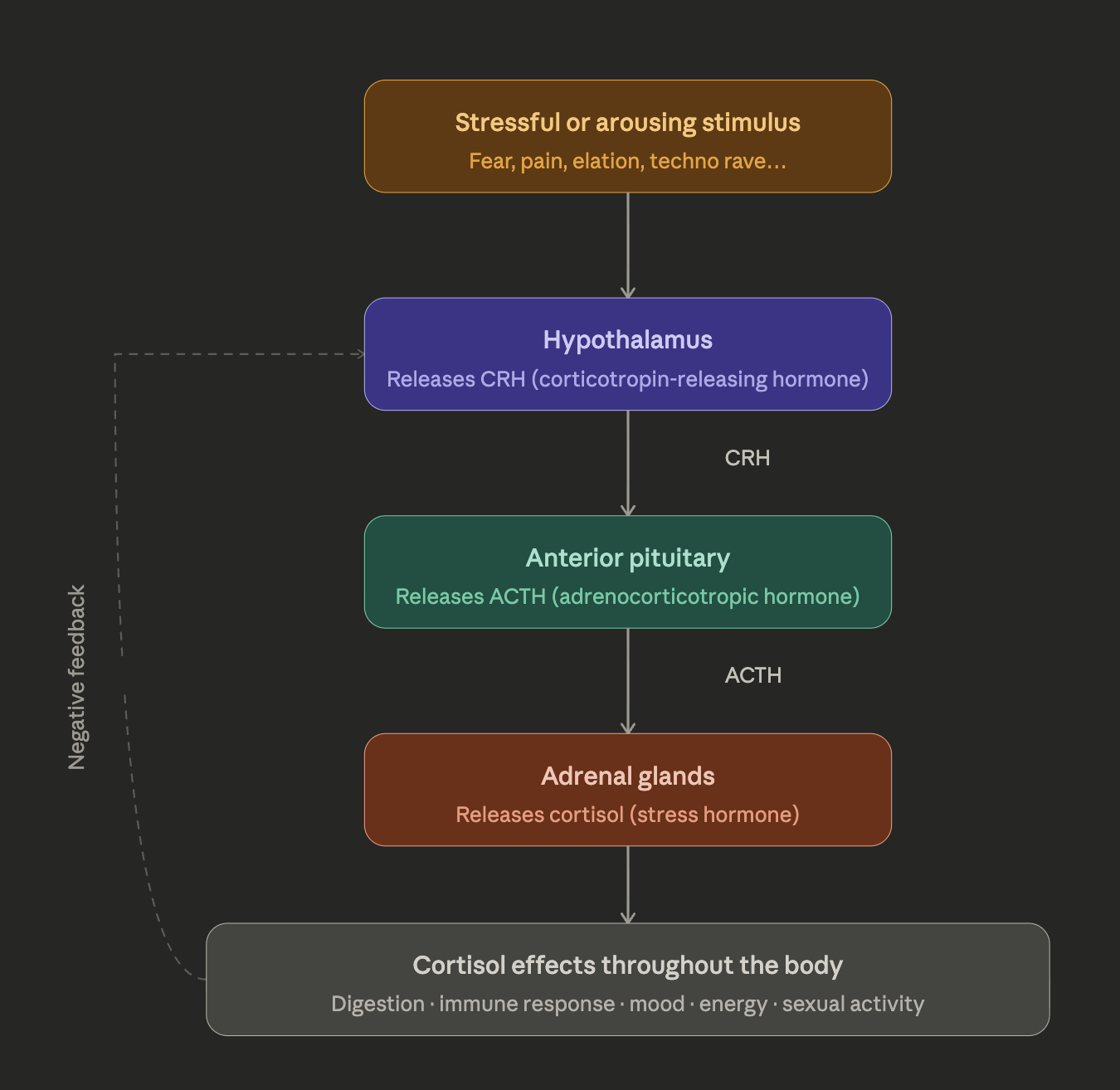
The hypothalamic-pituitary-adrenal axis (HPA axis) is a major neuroendocrine system that controls reactions to stress and regulates many body processes, including digestion, immune responses, mood and emotions, sexual activity, and energy storage and expenditure.
When you are frightened, elated, in pain, or apparently when you are at a techno rave, this system activates. The process works as a chain reaction: in response to a stressful or arousing situation, the hypothalamus releases corticotropin-releasing hormone (CRH), which triggers the anterior pituitary to release ACTH, which in turn triggers the adrenal glands to release cortisol.
The system is designed with a feedback loop where cortisol signals back to the hypothalamus to stop producing CRH, bringing the system back to baseline. There is also bidirectional communication and feedback between the HPA axis and the immune system. A number of cytokines can activate the HPA axis, while high levels of cortisol in turn suppress immune and inflammatory reactions, protecting the organism from overactivation. The neuroendocrine system, in other words, is the body's grand unified field, touching stress, immunity, mood, metabolism, and memory all at once.
Over- or underproduction of cortisol can result in diseases like Cushing's and Addison's, but less severe dysregulation of the HPA axis can still have significant adverse health consequences. Recurrent or persistent activation is associated with adverse outcomes across almost every domain of physical and mental health, and experience of adversity during early life is positively correlated with disrupted adult HPA axis function.
Gerra's team found that 30 minutes of techno music could meaningfully shift ACTH, beta-endorphin, norepinephrine, cortisol, and growth hormone levels in healthy young adults, demonstrating that an environmental stimulus — pure sound — could reach into this elaborate biological conversation and change what was being said.
Psychedelics and the Neuroendocrine Door
It’s a revolution! Honestly.
Psychedelic-assisted therapy — with its carefully appointed rooms, its trained guides, its liability waivers and its playlists vetted by a committee — is kind of like a dancefloor with a medical license, and many more harm reduction measures in place. The rave figured out in 1988 that if you dim the lights, play the right music, and give people something to dissolve their ego with, a hell of a lot of processing happens. For many, a Wednesday night in Manchester and a decent sound system really did the trick.

Be that as that may, the clinical container is a door that didn't exist before. (“The Portal” by Taudalpoi)
Substances that were dismissed, criminalized, and locked away for half a century are returning to clinical settings with striking results, and the mechanism by which they work brings us back, inevitably, to the same neuroendocrine architecture that techno music was found to perturb. Classical psychedelic drugs including psilocybin, DMT, LSD, and mescaline are agonists at serotonin receptors, but their reach extends far deeper than a receptor type.
ACTH and cortisol increases have been found in humans after oral ingestion of LSD, psilocybin, and ayahuasca, as well as intravenous administration of DMT. Psychedelics, like a well-engineered techno track, are activating the HPA axis. The biochemical fingerprint looks remarkably familiar. Psychedelic drugs target the hypothalamus, influencing both the brain and the body, and induce the overproduction of various hypothalamic-controlled hormones including oxytocin, prolactin, ACTH, and cortisol. But unlike chronic stress, which dysregulates these same systems with damaging consequences, psychedelics appear to produce a transient, reset-like activation that, in the right context, can be profoundly healing.
The HPA axis operates as the main neuroendocrine stress response system. Hyperactivity of the HPA axis is observed in major depressive disorder, with increased cortisol levels seen during depressive episodes. In PTSD, decreased cortisol in response to chronic stress is often observed, leading to dysregulation of the sympathetic nervous system. Both conditions represent forms of neuroendocrine dysregulation and both are precisely the conditions where psychedelic therapy has shown its most dramatic results.
The neuroendocrine system should be considered among the many potential targets for lasting therapeutic benefit. Researchers are increasingly convinced that psychedelics don't simply create a good feeling, but temporarily restructure the hormonal signaling environment in ways that allow the brain to form new associations, release old trauma patterns, and recalibrate towards health.
The Convergence
Here is where the threads converge into something genuinely strange and hopeful. Techno music shifts cortisol and beta-endorphin. Psychedelics shift cortisol and beta-endorphin. The neuroendocrine system appears to be the common language through which both powerful sound and powerful molecules speak to the body's capacity for transformation. And researchers are now deliberately combining them. Music has been identified as a central therapeutic function in psychedelic therapy. A study of patients undergoing psilocybin-assisted therapy for treatment-resistant depression found that the nature of the music experience was significantly predictive of reductions in depression one week after the session, whereas general drug intensity was not (Kaelen et al., 2018). The music mattered more than how high people got.
Music has been used in rituals across the world to achieve changes in consciousness throughout history, at times in combination with plants containing psychedelic compounds. The classic psychedelics produce their effects through serotonin system stimulation, and the use of music to support the acute psychoactive effects of psilocybin is now recommended in current clinical guidelines. Yet those guidelines have historically defaulted to Western classical music like Brahms, Bach, and Gregorian chant. The assumption that classical music was uniquely suited to therapeutic psychedelic work has been challenged by experiment. A randomized study comparing Western classical music with overtone-based music during psilocybin sessions found that mystical experience scores tended to be higher in overtone-based sessions, with six of ten participants choosing the alternative music for their final session (Yaden, et al., 2021) The dominance of classical music in psychedelic therapy settings is no longer a given, in a small (n=10), but striking pilot study.
Electronic music sits at a fascinating intersection in this conversation. Rave culture's roots in transcendence via dance music play a factor in why electronic sounds are increasingly employed in new treatment contexts, and electronic artists are among the first in the 21st century to design sound specifically for altered states of consciousness. Indigenous peoples have utilized longform rhythmic music for thousands of years in plant medicine traditions; the emergence of carefully produced electronic music for psychedelic therapy is the contemporary Western adaptation of an ancient formula.
The Gerra study showed us that electronic music, even without a dancefloor, even without drugs, even in a clinical setting, can shift the same hormonal machinery that psychedelic medicine now targets therapeutically. The neuroendocrine system is not a byproduct of our emotional lives; it is their biological substrate. When it is well-regulated, we are resilient, connected, and capable of growth. When it is chronically dysregulated by trauma or stress, the downstream effects reach everywhere: immunity, digestion, cognition, mood, and longevity.
Psychedelic medicine is learning to reset that system. Music is be part of the mechanism. The novelty-seeking individual who mounts the strongest hormonal response to a techno track, who feels the drop in their chest and in their chemistry, is living out a biochemical experiment in real time.
As the science advances and the tools of neuroendocrinology become more precise, we are beginning to understand that the rave, the ceremony, the therapy room with the eyeshades and the carefully curated playlist — these are all, in their different ways, attempts to use sound to reach the same inner architecture.
If you’ve read this far, here’s your prize: Trending Techno Tracks of the 90’s
https://open.spotify.com/playlist/1phzokOXWavNBteesASxZs?si=lTzjwAS_ThmovagPUFDnGA
References
Primary Source: Gerra G, Zaimovic A, Franchini D, et al. "Neuroendocrine responses of healthy volunteers to 'techno-music': relationships with personality traits and emotional state." Int J Psychophysiol. 1998;28(1):99–111.
Kaelen M, Giribaldi B, Raine J, et al. "The hidden therapist: evidence for a central role of music in psychedelic therapy." Psychopharmacology. 2018;235(2):505–519.
Yaden DB, et al. "Set and Setting: A Randomized Study of Different Musical Genres in Supporting Psychedelic Therapy." ACS Pharmacology & Translational Science. 2021;4(2):472–478.